
A well-formed diamond is extremely rare and highly valuable. Diamonds arrive at your local retail store through a lengthy and demanding process. GIA (Gemological Institute of America), the world’s foremost authority on diamonds (as well as coloured gemstones and pearls), plays a significant role in the journey of a diamond from mine to market.
Gemstone quality diamonds are nearly 100 percent pure carbon, and are the only gemstone mineral made from a single element. They are formed at depths estimated between 125-200 kilometers below the Earth’s surface. The pressure is around 50,000 times greater than the atmospheric pressure at the Earth’s surface, and the temperature range is approximately 900°C to 1300°C.

Diamonds require specific geological conditions to form, so they cannot be found everywhere. Southern Africa produces the majority of the world’s diamonds, and they are also produced in Russia, Canada, Australia, India, China and various South American countries.
Mining diamonds
Most diamonds occur in kimberlite pipes in a type of potassic volcanic rock. Two of the most common methods to extract diamonds are open-pit mining and underground mining. Open-pit mining involves large surface excavation, while underground mining is employed for reaching depths no longer economically feasible via the open-pit method. Diamonds are also extracted from alluvial deposits, where they are removed from sand, gravel, or clay along the banks of a river, a shoreline, or an ocean bed.
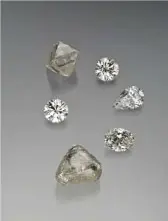
India cuts approximately 92 percent of the diamonds mined worldwide, and accounts for nearly 65 percent by value. Surat, which had its start processing diamonds from Australia’s Argyle mine, is at the heart of India’s manufacturing. The city now dominates globally as a processing centre, polishing close to 90 percent by volume, and about 57 percent by value. It owes its success to its ability to process a wide range of sizes and qualities.
A polished diamond must pass a final inspection before it can be used in jewellery. The diamond is boiled in a solution of hydrochloric and sulfuric acid to cleanse it of oil, diamond powder, and debris, and then is examined to ensure that it meets the manufacturer’s quality standards. Once a diamond passes inspection, it is ready for sale. Jewellers classify the physical attributes of diamonds using the 4Cs of diamond quality--Colour, Cut, Clarity and Carat Weight—as well as the International Diamond Grading System™. Both the 4Cs and the International Diamond Grading System were developed by GIA to objectively compare and evaluate diamonds.

Clarity: Clarity refers to the presence or absence of inclusions in a diamond. The majority of natural inclusions are invisible to the naked eye, yet they affect the way light is reflected and refracted within the stone. Inclusions appear as different shapes, such as crystals, clouds, or feathers.
Colour: The colour grade ranges from “D,” indicating virtually colourless, to “Z,” representing the largest presence of colour. Keep in mind that the closer a diamond is to the colourless end of the scale, the more light it will reflect. Reflected light equals more brilliance.
Cut: Though difficult to analyze or quantify, the cut of any diamond has three attributes: brilliance (the total light reflected from a diamond), fire (the dispersion of light into the colours of the spectrum), and scintillation (the flashes of light, or sparkle, when a diamond is moved).
Purchasing a diamond is a sentimental as well as a financial investment. The values you attach to your diamond should guide the worth of your purchase.

GIA’s International Diamond Grading System, which includes the D-to-Z colour scale, Flawless to I3 clarity scale, and the Excellent to Poor cut scale, provides a universal language for every diamond buyer in the world. GIA is not affiliated with any retailer, wholesaler or manufacturer, which means gem professionals and consumers can rely on GIA reports as the gold standard for objective certification.
Jewellers and retailers selling diamonds must know the value of their products and be able to clearly convey this to their customers. Meanwhile, consumers should play a proactive role by becoming knowledgeable about their intended purchases. Mutual trust and confidence is the key to building a long-lasting relationship between a seller and consumer.
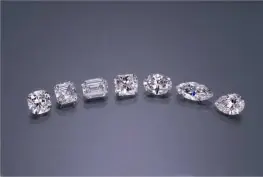
Various diamond cuts. From left: cushion, square-emerald, emerald, radiant, oval, marquise and pear-cut diamonds. Photograph by Robert Weldon © GIA